
In the Australian construction industry, what causes the most headaches is often not a lack of design creativity, but the endless, tedious tasks embedded in project delivery.
As a project approaches a DA (Development Application) or CDC (Complying Development Certificate) submission — or the point of issuing packages to contractors — teams are often overloaded with “data-handling” work:
Quantity Surveyors (QS) repeatedly recalculating areas and quantities;
Drafter moving data back and forth between drawings and schedules;
Project Managers dealing with multiple versions of changes and checking thick stacks of reports and plans line by line. While these steps require professional judgement, what truly consumes time and energy are the actions that must be done but are highly repetitive. In Australia, where labour costs are high and skilled talent is increasingly scarce, the most practical way to discuss the real value of AI starts with a simple question:
Can it compress the most time-consuming repetitive work in the project delivery chain?
1.What Is AI Actually Looking At? Not “Drawing Better”, but Turning Drawings into Data
In building delivery workflows, what AI truly excels at is not creative “creative output”, but transforming high-frequency, rule-based tasks into standardised production processes.
Whether you submit PDF drawings, BIM models, or point cloud data, AI essentially performs three core actions:
Recognition – identifying objects such as room boundaries, wall lines, doors and windows, and annotations.
Transcription – converting those objects into computable data structures, such as schedules and geometric relationship tables.
Output – generating results that can be calculated, cross-checked and traced, including areas, lengths and quantities.
2.Real-World Use Cases: Reducing Take-Offs from “Hours” to “Seconds”
Quantity take-off is one of the most repetitive stages in project delivery. Traditional workflows require scale calibration, manual tracing of boundaries, room delineation and component counting. Under time pressure, errors can easily accumulate.
Today, tools such as Togal have compressed this process dramatically:
Rapid processing – Upload the drawings, calibrate the scale, and with a single click the system typically produces results within 10–15 seconds.
Accurate extraction – Whether it is external wall perimeters, area measurements, or symbol-based counts, the results flow directly into a quantity panel for review and export.
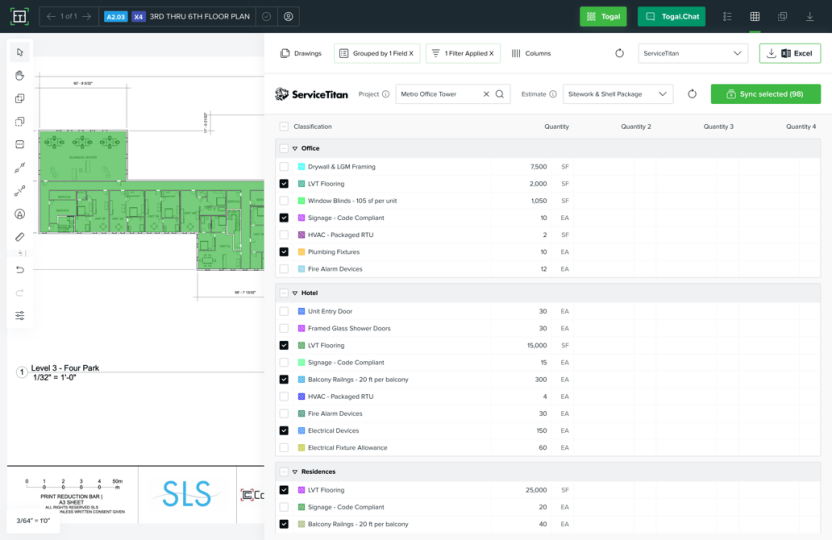
(The image above shows Togal’s automated quantity take-off interface.)
3.Policy Frontiers: “Smart Review” Now Used by NSW Planning Authorities
In Australia, the back-and-forth of post-submission amendments represents a major hidden cost. Government agencies such as the NSW Department of Planning are now rolling out AI-enabled solutions, focusing on pre-assessment and workflow triage.
With tools like PlanningAI, teams can run an early screening before investing large amounts of drafting time — checking whether a proposal is viable, which approval pathway applies, and what documentation is required. This front-loaded capability significantly reduces the risk of rejection and resubmission.
4. Who Does AI Really Replace? — The Shift in Work Priorities
A more realistic view for the Australian market is that AI replaces tasks, not entire professions.
What gets compressed first are:
1.Repetitive data extraction – Manually pulling areas, lengths and counts from drawings again and again.
2.Standardised production – The tedious work of assembling deliverables according to templates, naming rules and annotation styles (for example, Swapp claims up to a 50% reduction in documentation time).
3.Pre-submission checks – Running quality control before lodgement to reduce unproductive back-and-forth with councils.
As these steps are compressed, professional focus naturally shifts toward result verification, anomaly detection and expert judgement. Machines absorb the standardisable hours; people retain the accountable chain of responsibility.
Conclusion
In the AI era, the real moat lies in the delivery system itself.
If a company’s drawing standards, naming rules and checking frameworks are disordered, automation will only generate large volumes of low-quality output at greater speed. What will become truly scarce is the ability to systemise standards, evidence chains and quality control — and to let AI toolchains operate reliably within that structure.
As an Australian government-recognised Research Service Provider (RSP), Ignition Research (IR) focuses on helping construction and engineering businesses translate vague technical challenges into rigorous, compliant R&D frameworks.
If you are exploring how to use AI to optimise delivery in a high-cost environment, follow us and join the conversation on the construction industry’s next generation of productivity.
Frequently asked questions
Q: What does AI actually do with construction drawings in building delivery? A: According to the article, AI is not about drawing better but about turning drawings into data through three core actions: recognition (identifying room boundaries, wall lines, doors, windows and annotations), transcription (converting them into computable structures like schedules and geometric relationship tables), and output (generating areas, lengths and quantities that can be calculated, cross-checked and traced). The article notes this applies whether you submit PDF drawings, BIM models or point cloud data.
Q: How fast can a tool like Togal do a quantity take-off? A: The article says that with a tool such as Togal, you upload the drawings, calibrate the scale, and with a single click the system typically produces results within 10 to 15 seconds. It notes that external wall perimeters, area measurements and symbol-based counts flow directly into a quantity panel for review and export.
Q: How are NSW planning authorities using AI before a DA or CDC submission? A: The article says government agencies such as the NSW Department of Planning are rolling out AI-enabled solutions focused on pre-assessment and workflow triage. With tools like PlanningAI, teams can run an early screening before investing large amounts of drafting time to check whether a proposal is viable, which approval pathway applies and what documentation is required, which the article says reduces the risk of rejection and resubmission.
Q: Does AI replace construction professionals like quantity surveyors and drafters? A: The article argues AI replaces tasks, not entire professions, compressing repetitive data extraction, standardised production (it notes Swapp claims up to a 50% reduction in documentation time) and pre-submission checks. It says professional focus then shifts toward result verification, anomaly detection and expert judgement, with people retaining the accountable chain of responsibility.
Working on a project like this?
Tell us what you're building and the part you're not sure will work. A researcher from our Adelaide team (registered Research Service Provider RSP000047) reads every enquiry and replies within two business days. No documents needed.