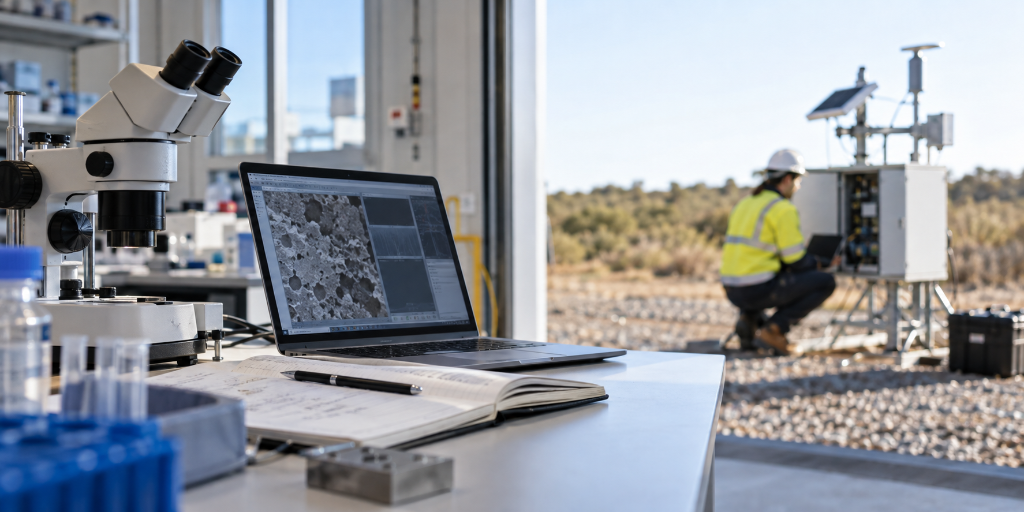
Quick answer: A successful laboratory result does not automatically establish that the same outcome will hold under operating conditions. A further experimental question may arise where a competent professional cannot determine in advance, from current knowledge, information or experience, whether a defined technical outcome will survive changes in scale, environment, variability or system interaction. The field trial should therefore test a specific remaining uncertainty rather than simply repeat the laboratory demonstration.
The 2026–27 Federal Budget announced proposed R&DTI reforms applying from 1 July 2028. Until those changes take effect, the R&DTI continues to operate under the current rules.
A Field Trial Should Answer a New Question
Moving from a controlled environment into the field changes more than location.
Laboratory experiments deliberately reduce variation. Temperature may be controlled. Inputs may be selected. Sensors may be calibrated immediately before a test. Operators may follow one procedure. Equipment may run for a short, defined period.
The field removes many of those protections.
Inputs vary. Equipment ages. Weather changes. Operators intervene. Communications drop out. Loads fluctuate. Other systems interact with the experimental system.
That does not mean every field trial is R&D.
If established engineering knowledge already allows the expected field behaviour to be determined, implementation and commissioning may be the appropriate next step. Moving from laboratory scale to field or production scale does not, by itself, create a core R&D activity. The relevant question remains whether the specific outcome can be known or determined in advance from current knowledge, information or experience, or whether further experimentation is required to determine it.
The useful research question is therefore not:
“Does the system still work outside the lab?”
It is something narrower:
“Which technically relevant change between the laboratory and operating environment could alter the outcome, and can its effect be determined in advance?”
That is what gives the field experiment a purpose.
Define the Transfer Risk Before Collecting Data
Consider a control system that performs reliably on a laboratory rig.
A team preparing a field test could identify several reasons why that result may not transfer:
• the input range is wider in operation;
• sensor noise is higher;
• environmental conditions change the response;
• components interact differently at operating scale;
• timing or communications delays alter the control behaviour; or
• the system must remain stable over a longer operating period.
Those are different potential sources of transfer uncertainty. Each could lead to a different hypothesis and experimental design.
Running the system in the field and recording everything may produce a large dataset, but it does not necessarily distinguish between those explanations.
A stronger design identifies the suspected transfer mechanism before the trial.
For example:
Hypothesis: The laboratory control method will remain stable under field conditions provided input variability stays within a defined operating envelope.
The experiment can then specify:
• the operating range to test;
• the parameter being varied;
• the conditions to hold constant where possible;
• the measurements that indicate stability;
• the baseline for comparison; and
• the result that would support or weaken the hypothesis.
Government guidance describes core experimental work as a systematic progression through hypothesis, experiment, observation, evaluation and logical conclusions. Records should explain how the experiment was conducted or planned and may, for example, identify the parameters that were varied, held constant, observed or measured.
The discipline matters even where the project is not ultimately treated as an R&DTI activity. It helps distinguish a designed experiment from commissioning activity that happens to generate technical data.
Record the Operating Envelope, Not Just the Headline Result
Suppose the system meets its target on most days but fails during high temperature, unusual loading or degraded communications.
Calling the trial either a “success” or “failure” loses useful information.
The result may instead define an operating envelope.
That envelope describes the conditions under which the evidence currently supports the technical conclusion — and the conditions outside which the result remains uncertain.
A field record should therefore connect each important observation to its context.
Useful records may include:
• hardware and software versions;
• sensor configuration;
• environmental conditions;
• input characteristics;
• operating mode;
• intervention by operators;
• deviations from the planned protocol;
• anomalies and excluded data; and
• the reason a later experiment was changed.
Current R&DTI record-keeping guidance identifies experimental plans, trial records, test reports and evaluations as examples of evidence supporting a systematic progression of work.
The purpose is not to make the trial look more successful.
It is to make clear what the result actually supports.
Know When the Research Question Has Been Answered
A field project can continue long after the original uncertainty has been resolved.
Once the team knows the relevant operating limits and can use established engineering approaches to implement within them, later optimisation, monitoring and routine performance tuning may fall outside the original experimental investigation. Any later activity should be assessed on its own facts rather than assumed to remain R&D simply because it occurs within the same project.
A useful decision gate is:
What outcome is still technically unknown, and what experiment is required to determine it?
If the team can answer that precisely, another experimental cycle may be technically justified. That does not, by itself, establish R&DTI eligibility; the activity must still satisfy the applicable requirements.
If the remaining work is applying what has already been learned, implementation may be the more accurate description.
The objective is not to keep a project labelled as research for as long as possible.
It is to know when research has produced enough evidence for engineering to take over.
A Field Trial and R&DTI Eligibility Are Separate Questions
A field trial is not automatically a core R&D activity because it occurs at a larger scale or under real operating conditions. Nor does moving into a production environment automatically make experimental work ineligible. The activity still needs to be assessed against the applicable R&DTI requirements, including whether the outcome could be known or determined in advance, whether it could only be determined by applying a systematic progression of work, and whether the activity was conducted for the purpose of generating new knowledge.
Conclusion
A successful laboratory result answers only the question tested under the conditions in which it was produced.
A useful field experiment identifies what remains uncertain when those conditions change, defines the operating variables that matter, and records enough context to explain why the field result agrees — or does not agree — with the laboratory result.
When that uncertainty has been resolved and established engineering knowledge is sufficient to guide implementation, the research question may have reached its natural boundary even though the wider project continues.
Sources & Further Reading
Australian Government — Conducting core R&D activities for the R&D Tax Incentive
business.gov.au — Conducting core R&D activitiesAustralian Government — Record keeping for the R&D Tax Incentive
business.gov.au — R&DTI record keepingbusiness.gov.au — Conducting supporting R&D activities for the R&D Tax Incentive
business.gov.au — Manufacturing sector guide for the R&D Tax Incentive
Talk to Ignition Research if a laboratory result now needs to be tested under operating conditions and you need to define what technical uncertainty remains between laboratory performance and field performance. As a Registered Research Service Provider, Ignition Research assists businesses with research question definition, experimental design, technical investigations and contemporaneous supporting records within its registered research fields.
RSP registration confirms that the provider has met the relevant registration requirements for its registered research fields. It does not constitute government endorsement of a project or guarantee R&DTI eligibility.
We do not determine R&DTI eligibility or provide tax advice. The R&D Tax Incentive is a self-assessment program, and companies remain responsible for assessing their activities, expenditure and circumstances and obtaining appropriate tax advice.
This article provides general information only and is not tax, legal or financial advice.
Working on a project like this?
Tell us what you're building and the part you're not sure will work. A researcher from our Adelaide team (registered Research Service Provider RSP000047) reads every enquiry and replies within two business days. No documents needed.
