Introduction
The Australian Government has long supported business R&D through policies such as the Research and Development Tax Incentive (R&DTI), encouraging businesses to address real industry problems through technical exploration and experimental validation.
For businesses, R&D does not necessarily mean creating an entirely new technology from scratch. Improvements to existing products, processes or engineering solutions may also form meaningful R&D projects. The key question is whether the relevant technical outcomes cannot be known or determined in advance on the basis of current knowledge, information or experience, and therefore need to be investigated through a systematic experimental process to generate new technical knowledge.
However, when businesses in traditional industries encounter problems relating to product performance, production efficiency or engineering applications, they may still tend to regard them as routine product improvements and overlook the technical uncertainty that may be involved.
Drawing on a case from industry practice, this article explores how businesses can start from practical industry problems, identify technical challenges that warrant further investigation, and develop them into R&D projects with defined research questions, hypotheses and validation pathways.
Industry Background & Technical Challenges
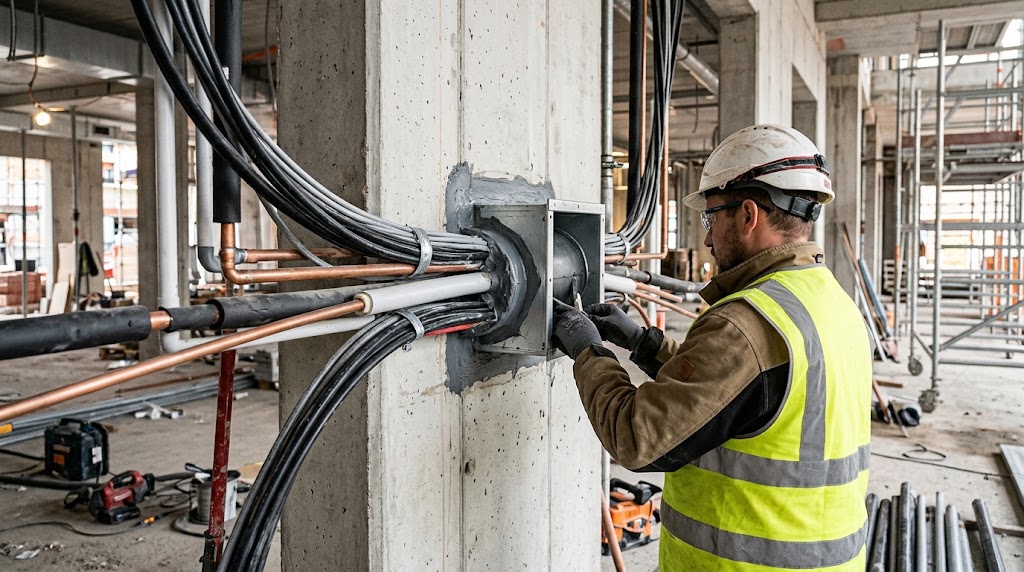
Passive fire protection is an important component of building safety systems. In practical construction projects, large numbers of cables, pipes and mechanical and electrical services need to pass through walls and floor slabs that provide fire separation. If these penetrations are not treated appropriately, the fire integrity of the original barrier may be compromised.
Traditional passive fire protection methods often require different services to be treated separately according to their materials and intended applications. In large building projects, this can increase the complexity of construction processes while creating challenges in installation, coordination and quality control.
An Australian Government case study on BOSS Fire and Safety similarly notes that traditional passive fire protection methods can be complex and costly, providing an important context for the company’s exploration of alternative solutions.
The underlying challenge therefore becomes more than simply “how to install a fire protection component”.
It becomes: How can a passive fire protection system be redesigned to improve installation efficiency while maintaining the required fire performance?
Real Research Case: BOSS Fire’s Passive Fire Protection R&D
It was against this industry background that Australian company BOSS Fire and Safety began exploring a product solution that differed from traditional approaches.
According to publicly available Australian Government R&DTI case study material, the company considered traditional passive fire protection methods to be relatively complex and costly and invested in R&D to explore a new product design that could simplify fire protection at locations where different services pass through fire-rated barriers.
One of the key outcomes of this R&D process was the FyreBox™ system. Compared with traditional approaches in which different services are treated separately for fire protection, FyreBox consolidates the fire protection treatment of multiple services within a single designed and tested device, reducing installation steps and improving construction efficiency. The Australian Government case study indicates that, on average, each FyreBox can reduce passive fire protection installation labour time by approximately 209 minutes.
The government case study also indicates that, after FyreBox was brought to market, BOSS continued to undertake R&D and explore new passive fire protection products. Publicly available information confirms that BOSS invested substantial R&D effort in the development and testing of FyreBox, but does not disclose its specific research hypotheses, technical variables or experimental design.
This raises a further question worth considering: for passive fire protection products of this type, when the product structure, material configuration or application method changes, can the resulting performance be determined in advance on the basis of current knowledge? If not, how should the uncertainty be investigated through systematic experimentation?
From Industry Problem to Research Problem
Encountering a technical problem in day-to-day business operations does not automatically make the resulting product development R&D simply because a new product is being developed.
To develop an industry problem into an R&D project, several key questions need to be addressed:
Which technical outcomes cannot currently be determined directly from existing knowledge and experience;
Which factors may influence the final outcome; and
How different approaches can be systematically tested and validated.
It is important to note that publicly available information does not disclose the specific research hypotheses, experimental variables or experimental design used by BOSS Fire during the development of FyreBox. The following discussion therefore does not reconstruct its actual R&D process. Instead, it uses the types of technical challenges that may arise in the development of similar passive fire protection products to illustrate how an engineering problem could be further developed into an R&D project with a research question, research hypothesis and validation pathway.
Potential Research Question
If a business seeks to redesign a traditional approach in which fire protection treatments are applied separately into a more integrated product system, an illustrative research question could be: How can the structure and material configuration of a passive fire protection system be redesigned so that it can accommodate different service penetration conditions while maintaining stable fire performance and reducing installation complexity?
The focus of this question is not simply to achieve “faster installation”, but to further investigate: how is fire performance affected when the product structure, material configuration and combination of different services change?
If current publicly available knowledge, technical information and relevant professional experience are insufficient for a competent professional in the relevant field to determine in advance how a new design will perform under these conditions, that uncertainty would need to be investigated through experimentation.
Potential Research Hypothesis
Based on the research question above, an illustrative testable hypothesis could be: If the product structure is redesigned and the fire protection materials and spatial relationships between different services are appropriately configured, the system may be able to maintain stable fire performance under predefined application conditions while reducing the installation steps required by traditional methods.
This hypothesis cannot be demonstrated through product design alone and would need to be validated through experimental results. The R&D team could compare test results across different structural designs, material configurations and service combinations.
If a particular approach fails to achieve the expected performance, the team would need to further analyse the technical factors contributing to the difference, adjust the design and conduct further validation.
The R&D process therefore needs to answer more than simply, “Can this product pass the test?” It also needs to ask: why do different designs produce different results, and which technical factors actually influence the final performance?
Potential Research Factors
To investigate the questions above, an R&D team would need to identify key variables that may influence the technical outcome:
Product Design Factors: Product structure, internal space, material combinations, sealing methods and the spatial relationships between different components.
Application Condition Factors: The type, number and size of penetrating services, their arrangement, and the spatial relationships between different services.
Performance Factors: Fire integrity, insulation performance, fire-resistance duration and the consistency of performance results across different configurations.
Construction Factors: Installation steps, construction methods and site conditions, as well as the impact of changes in product design on installation efficiency and operability.
The purpose of identifying these factors is not simply to list product parameters, but to help the team determine which variables may cause the technical outcome to change. Only by further establishing the relationship between these variables and observable, measurable outcomes can experimentation develop from simple product testing into a research process that helps explain the technical problem.
Research Design & Methodology: Reducing Technical Uncertainty
For this type of engineering product R&D, a validation pathway can be established around design, testing, analysis and iteration:
1. Product Structure & Material Configuration: During the initial design stage, identifying key factors that may affect fire performance and developing comparative design options.
2. Variable Testing & Factor Analysis: By varying key parameters such as service type, count, cross-sectional dimensions and layout arrangement, comparing test results under varied penetration conditions to isolate the factors with the greatest influence on fire performance.
3. Practical Application & Efficiency Validation: Subjecting optimised designs to thorough performance and site-readiness validation while quantifying installation time reduction and operational ergonomics.
The overall R&D process follows a continuous iterative pathway:
Research question & hypothesis → Experimental design → Testing & observation → Evaluation of results → Logical conclusions → Adjustment of hypothesis or design → Further validation
Through this process, a broad industry objective such as “improving installation efficiency and reducing construction complexity” can be progressively developed into an R&D project with a research question, research hypothesis, technical variables and an experimental validation pathway.
For businesses developing traditional engineering products, the important point is not simply to describe new product development as R&D. Rather, it is to identify which technical outcomes cannot be determined directly from current knowledge and to systematically investigate and reduce that uncertainty through experimentation.
Expected Outcomes & Industry Implications
In engineering fields such as passive fire protection, the value of R&D is not limited to the development of a new product. More importantly, through ongoing design, experimentation and validation, businesses can progressively identify the key factors that influence product performance, establish more systematic methods for evaluating performance, and develop technical knowledge that can support subsequent product optimisation and expansion into new applications.
The experimental data, test results and technical experience accumulated through this process can also progressively become part of the business’s own knowledge assets, providing a foundation for future R&D and product iteration.
The BOSS Fire case illustrates how traditional building product businesses can identify R&D opportunities in long-standing engineering problems. For other building material, engineering product and manufacturing businesses, the important point is not to replicate a particular product, but to reconsider the technical problems within their own operations that have existed for a long time but have not yet been fully resolved.
When a business attempts to change the structure, materials or operating method of a mature product, and the resulting technical outcomes cannot be known or determined in advance on the basis of current knowledge, information or experience, this may indicate the presence of a technical unknown that warrants further investigation. The next question is whether resolving that unknown requires a systematic experimental process conducted for the purpose of generating new knowledge.
This is also where Ignition Research can add value to the design of business R&D projects: starting from real industry problems, identifying the technical uncertainty involved, and helping businesses establish R&D projects with clearly defined research questions, research hypotheses, key variables and validation pathways.
This article provides general information only. R&DTI eligibility depends on the specific activities undertaken and the relevant circumstances. Businesses should assess individual activities against the applicable legislation and current Australian Government guidance.
Working on a project like this?
Tell us what you're building and the part you're not sure will work. A researcher from our Adelaide team (registered Research Service Provider RSP000047) reads every enquiry and replies within two business days. No documents needed.
