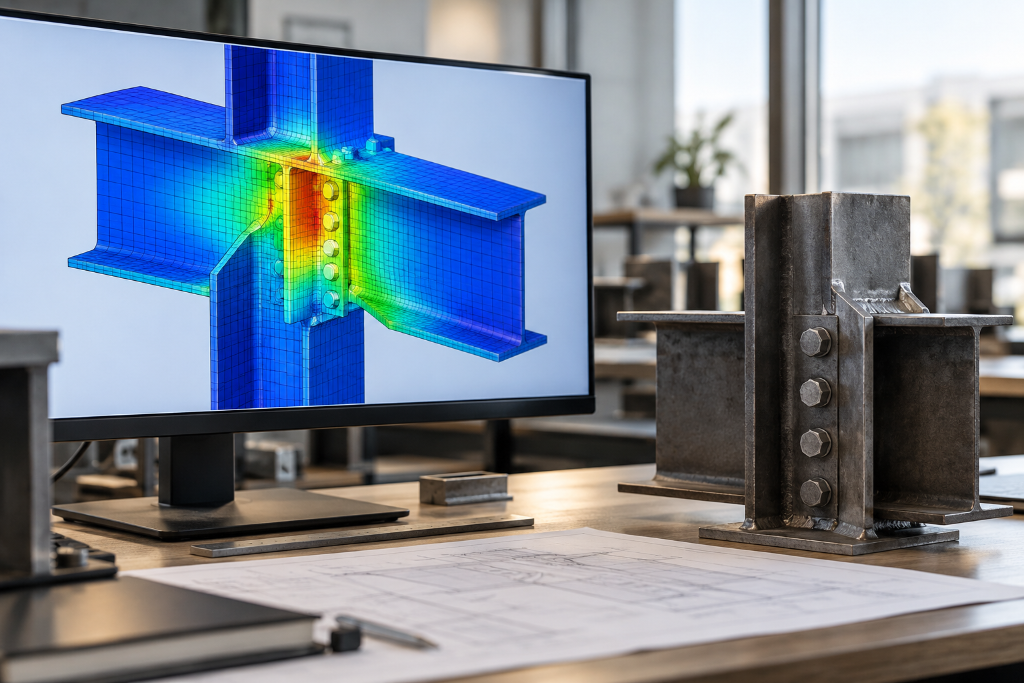
Quick answer: A simulation can form part of a genuine experiment; the R&DTI rules do not require every experimental activity to occur on a physical prototype. The harder question is whether the model is being used to investigate an outcome that genuinely cannot be known or determined in advance, or merely applying an established method to calculate an expected result. Where the model’s predictive behaviour under the relevant conditions is itself uncertain, simulation and appropriately targeted physical validation may form part of one connected research pathway.
Running a model is not automatically an experiment
Modern engineering can answer questions without building the thing first.
A structural team can test hundreds of geometries computationally. A manufacturer can model heat transfer before cutting tooling. A process engineer can simulate flows through equipment. A software team can create synthetic operating conditions that would be difficult or expensive to reproduce live.
CSIRO describes computational modelling as a way to examine the operation of manufacturing processes, systems and equipment, including running virtual trials that can replace some costly physical experimental tests. CSIRO
That makes simulation a powerful research tool.
It does not make every simulation run research.
Under section 355-25 of the Income Tax Assessment Act 1997, a core R&D activity must involve an outcome that cannot be known or determined in advance on the basis of current knowledge, information or experience, but can only be determined through a systematic progression of work based on principles of established science, proceeding from hypothesis to experiment, observation and evaluation and leading to logical conclusions. The activity must also be conducted for the purpose of generating new knowledge. Federal Register of Legislation
Suppose an engineer uses a well-established finite-element model to calculate the deflection of a conventional component under a defined load.
The geometry may be new.
The analysis may be computationally demanding.
The engineer may need substantial skill to set it up correctly.
But if the model, physical assumptions and expected relationship are established well enough that a competent professional could determine the outcome in advance, running the calculation is more naturally characterised as engineering analysis.
Now change the question.
Suppose the team is developing a materially different composite assembly, and existing constitutive models produce conflicting predictions because the interface behaviour under cyclic loading has not been established. The team proposes a new modelling approach and systematically compares its predictions with measured behaviour.
The simulation is no longer just calculating an answer.
It is part of an investigation into whether a technical explanation is valid.
Ask what is uncertain: the system or the model?
Simulation projects become much clearer when the team separates two uncertainties.
The first concerns the real system.
Will the component buckle under a particular combination of geometry and load? Will a process remain stable when throughput increases? Will a control strategy recover correctly after a disturbance?
The second concerns the model.
Does the mathematical or computational representation predict that real behaviour accurately enough for the decision being made?
Those questions are related, but they are not identical.
A model may be perfectly adequate inside a validated range and unreliable outside it.
For example, an established process model may predict behaviour accurately under ordinary temperatures and feed rates. A new project pushes the process into a region with substantially different material behaviour.
Running the existing model may generate a very precise number.
That does not establish that the number is physically meaningful.
The technical uncertainty may therefore become:
Does the existing model remain predictive under these new conditions?
A useful experiment might compare model predictions against strategically chosen physical observations.
Alternatively, the research question could concern a new modelling method itself:
Can a reduced-order model preserve the relevant physical behaviour closely enough to replace a computationally expensive solver for this decision?
In that case, the experiment may primarily occur computationally. The team could define benchmark cases, vary relevant conditions, compare predictions against an accepted reference and evaluate where the approximation fails.
Australian Government guidance expressly recognises that experiments can take different forms and occur in different environments. The experiment must still be logically designed to test the hypothesis, while records should explain how it was conducted or planned and may, for example, describe the parameters varied, held constant, observed or measured. business.gov.au
The important distinction is therefore not physical versus digital.
It is known calculation versus unresolved technical relationship.
Validate where the model could change the decision
Physical testing is expensive, so the instinct to replace it with simulation is understandable.
The opposite instinct—testing everything physically—is not necessarily better.
A useful research programme asks where physical evidence has the highest information value.
Suppose a model contains ten assumptions, but existing literature and prior testing provide strong evidence for nine of them. The remaining uncertainty is one interface condition that dominates the predicted failure behaviour.
Building ten prototypes may add less knowledge than running one carefully designed physical test that isolates that interface.
The purpose of validation is not simply to make the simulation “look accurate”.
It is to test the assumption that matters to the decision.
CSIRO facilities illustrate this relationship between simulated and physical environments in practice. Its Renewable Energy Integration Facility combines real-time digital simulation with physical equipment and emulation to investigate complex grid behaviour under realistic conditions. CSIRO
The same logic applies at smaller scale.
A manufacturer may simulate the entire process but instrument only the point where the model predicts a transition.
A structural developer may model many configurations but physically test the joint behaviour that drives the uncertainty.
A software team may simulate millions of conditions but run selected real-system tests where the simulation assumptions are least secure.
This creates a more useful question than:
“Do we need physical testing?”
Ask instead:
“Which physical observation would most strongly confirm or challenge the assumption our decision depends on?”
That can make validation part of the experimental pathway rather than a ceremonial final check, provided it is testing an unresolved hypothesis rather than simply confirming performance against an established expectation.
Keep the model version inside the evidence chain
Simulation creates another problem that physical prototypes make easier to notice: the experiment can change without appearing to change.
A solver version is updated.
A boundary condition changes.
A material property is replaced.
The mesh changes.
A preprocessing script filters the input differently.
The output still looks like the same graph.
If those changes are not recorded, later results may be impossible to compare.
Current Australian Government record-keeping guidance states that records should be created at the time the activity is conducted. Examples of records that may demonstrate the systematic progression include experimental plans, records of trial runs and test reports showing results and evaluation. business.gov.au For simulation-led research, a practical traceability approach should also preserve the computational conditions needed to reconstruct the experiment.
The useful record is not merely a screenshot of the final result.
It should make clear which hypothesis was being tested, which model version produced the result, which assumptions and inputs were used, what parameter was varied, what reference or physical evidence was used for comparison, and what the team concluded from the difference between prediction and observation.
That matters commercially as much as it does for research governance.
A CFO deciding whether to fund tooling does not need another colourful simulation.
They need to know whether the model has been tested strongly enough to justify relying on it.
A CTO or engineering lead should be able to say where the model is trusted, where it is extrapolating and what evidence would cause the team to stop relying on it.
Simulation can reduce the need for physical experimentation.
Sometimes it can become the main experimental environment.
But the model should not quietly become the evidence for its own validity.
The stronger research pathway is the one that makes clear what is already established through existing knowledge and model validation, what remains technically uncertain and where physical evidence is still needed to test the model’s predictions.
Sources & Further Reading
Australian Government — Conducting core R&D activities for the R&D Tax Incentive
Australian Government — Record keeping for the R&D Tax Incentive
Federal Register of Legislation — Income Tax Assessment Act 1997, Division 355
Australian Government — Get help from a research service provider
Talk to Ignition Research if your project is relying on simulation to replace expensive prototypes or physical trials and the unresolved question is whether the model is predictive enough under the conditions that matter to the investment decision. As a Registered Research Service Provider, Ignition Research assists businesses with research question definition, experimental design, technical investigations and contemporaneous supporting records within its registered research fields. business.gov.au
RSP registration confirms that the provider has met the relevant registration requirements for its registered research fields. It does not constitute government endorsement of a project or guarantee R&DTI eligibility.
We do not determine R&DTI eligibility or provide tax advice. The R&D Tax Incentive is a self-assessment program, and companies remain responsible for assessing their activities, expenditure and circumstances and obtaining appropriate tax advice.
Working on a project like this?
Tell us what you're building and the part you're not sure will work. A researcher from our Adelaide team (registered Research Service Provider RSP000047) reads every enquiry and replies within two business days. No documents needed.