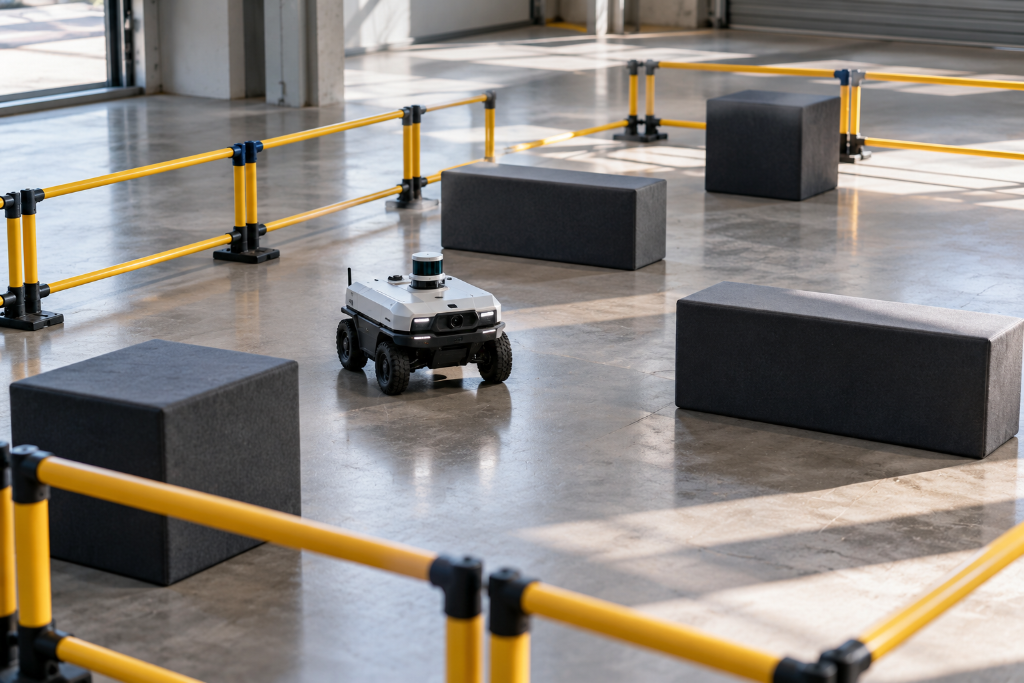
Quick answer: Potentially hazardous technical failures can sometimes be investigated through simulation, isolated subsystem experiments and progressively bounded physical testing without deliberately producing the full dangerous event. The appropriate method depends on the failure mechanism, how well the experimental model represents the real system and what uncertainty remains. A responsible research plan should make clear what each stage can establish — and what it cannot.
When the Technical Question Involves an Unsafe Outcome
Some research questions are difficult to investigate because the event of interest could cause significant damage or create unacceptable safety risks.
An autonomous industrial vehicle may need to respond safely when a sensor supplies unreliable information.
A building monitoring system may need to identify an emerging structural problem before the condition becomes critical.
An automated manufacturing process may need to detect a control failure before equipment or materials are damaged.
In each case, the business wants evidence about system behaviour under abnormal conditions.
However, deliberately allowing the complete failure to occur may be inappropriate.
The research challenge is therefore to separate the technical uncertainty from the full hazardous consequence.
For example, a company developing an autonomous inspection vehicle may be uncertain whether its control algorithm can identify contradictory sensor readings quickly enough to change its operating state.
Testing that uncertainty does not necessarily require creating a real collision.
The team may first investigate sensor interpretation, decision logic and response timing in controlled environments.
The critical research question concerns the technical behaviour of the system, not the production of the dangerous incident itself.
A useful starting question is therefore:
What part of the failure mechanism actually needs to be observed to test the hypothesis?
Build the Evidence in Stages
Where the complete failure event cannot reasonably be reproduced directly, a staged experimental pathway can help distinguish what can be tested from what must still be inferred.
The objective is not to make each experiment progressively more dangerous.
It is to use each stage to determine what evidence is still needed.
Begin with analytical models and simulation
Simulation can provide an initial environment for exploring conditions that would be difficult or unsafe to reproduce physically.
Researchers may vary sensor inputs, operating conditions or system responses to investigate hypotheses about failure behaviour.
However, simulated findings depend on the assumptions and fidelity of the model.
If the model omits an important physical interaction, the simulated result may not accurately represent the real system.
The team should therefore distinguish between assumptions already supported by existing knowledge and assumptions that remain part of the technical uncertainty.
A successful simulation may establish how the system behaves within the model.
It does not automatically establish that the physical system will behave identically.
The simulation may instead help identify which physical behaviour needs to be tested next.
Isolate the relevant subsystem
Where practical, a potentially hazardous mechanism can be investigated using a smaller or disconnected subsystem.
For an autonomous vehicle, researchers might test perception and control responses without permitting the vehicle to move.
For industrial monitoring software, simulated sensor data may be introduced into a separate testing environment rather than into the operational control system.
A component may be tested independently before it is integrated into a larger assembly.
Isolation can reduce the consequences of an experimental error while still allowing the relevant behaviour to be observed.
But the research team should remain clear about what has been removed from the experiment.
If the unresolved question depends on an interaction between the subsystem and the wider physical system, an isolated test may only answer part of the question.
Progress to bounded physical testing where necessary
Physical testing may become useful when the remaining uncertainty depends on interactions that simulation or isolated subsystem testing cannot adequately represent.
Environmental interference, mechanical response, sensor placement or other physical effects may influence system behaviour.
A more representative trial can then be designed around the unresolved technical relationship.
The purpose is not to reproduce the most severe possible failure.
It is to investigate the behaviour that still needs evidence within appropriately controlled experimental limits.
This creates a useful question before moving to a more representative test:
What additional technical evidence will this stage provide that the earlier experiments could not?
If that question cannot be answered clearly, increasing physical realism may add complexity or risk without resolving the important uncertainty.
Be Clear About What the Evidence Can and Cannot Establish
One of the main difficulties in hazardous-failure research is deciding how much confidence indirect evidence can support.
A successful simulation does not prove that the real system will respond identically.
Likewise, a controlled physical trial may establish performance under specific conditions without demonstrating reliability across every possible abnormal event.
Consider an industrial inspection system designed to detect equipment deterioration.
Researchers might demonstrate that the detection method responds to selected representative fault conditions.
A defensible conclusion might be:
The detection method identified the tested fault signatures under the defined experimental conditions.
That is different from:
The system will detect every physically possible failure in operation.
The second claim extends beyond the evidence produced by the experiment.
The same distinction applies across different stages of testing.
A simulation may support a conclusion about behaviour within a defined model.
An isolated subsystem experiment may support a conclusion about one part of the system.
A bounded physical trial may show that the behaviour persists under a defined set of real-world conditions.
Each stage can strengthen the evidence without automatically answering every later question.
A responsible research record should therefore distinguish:
• what was directly observed;
• what was predicted through a model;
• which assumptions remain;
• which conditions were not tested; and
• what uncertainty remains before the next stage.
This is particularly important where a technically successful experiment could otherwise be interpreted as broader evidence than it actually provides.
Technical Uncertainty and R&DTI Considerations
The presence of a safety risk does not itself make an activity eligible for the Australian R&D Tax Incentive.
Under the current rules, a core R&D activity must be conducted for the purpose of generating new knowledge and involve an outcome that cannot be known or determined in advance on the basis of current knowledge, information or experience.
That outcome must be determined through a systematic progression of work based on principles of established science, proceeding from hypothesis to experiment, observation and evaluation and leading to logical conclusions. business.gov.au
A technically uncertain failure mechanism may require that kind of experimental investigation.
But the fact that a system is safety-critical, difficult to test or expensive to damage does not by itself establish a core R&D activity.
The relevant question remains whether the particular activity is investigating an outcome that could not be determined in advance and whether the required experimental progression is present.
The reverse is also important.
Avoiding the full hazardous event does not mean an experiment is incapable of generating useful research evidence.
Simulation, subsystem testing and bounded physical trials can each contribute to the investigation where they are logically connected to the hypothesis and their limitations are understood.
Research findings should also remain separate from any safety, operational or regulatory requirements that apply before a system can be deployed.
Record Why Each Experimental Stage Was Used
Record keeping becomes particularly important when the ultimate failure scenario is not reproduced directly.
Current R&DTI guidance states that records should be created at the time the activity is conducted. Examples of records that may demonstrate the systematic progression include experimental plans, records of trial runs and test reports showing results and evaluation. business.gov.au
For hazardous-failure research, a practical technical record may also explain:
• the hypothesis being tested;
• the experimental model or subsystem used;
• why that setup was appropriate to the technical question;
• the conditions tested;
• the observations obtained;
• the assumptions connecting the experiment to the wider system;
• the conclusions supported by the evidence; and
• what the experiment did not establish.
This is a practical research framework rather than a prescribed R&DTI record format.
Its purpose is to preserve the boundary between the evidence actually produced and the broader failure behaviour that remains untested.
That boundary becomes especially important when later engineering or investment decisions rely on the research findings.
Conclusion
Investigating a dangerous failure does not necessarily require deliberately creating the complete dangerous event.
The research task is to identify the technical mechanism that remains uncertain and test it at the most appropriate level.
Simulation may answer part of the question.
An isolated subsystem may answer another part.
A bounded physical trial may be needed where important real-world interactions remain unresolved.
What matters is not how dramatic the experiment appears, but whether each stage tests the hypothesis and whether the conclusions stay within the limits of the evidence produced.
Sometimes the most useful finding is that the current evidence is not yet strong enough to justify moving to a more representative test.
That is still a useful research outcome.
Sources & Further Reading
Australian Government — Conducting core R&D activities for the R&D Tax Incentive
Australian Government — Record keeping for the R&D Tax Incentive
Federal Register of Legislation — Income Tax Assessment Act 1997, Division 355
Talk to Ignition Research if your team needs to investigate uncertain failure behaviour but the complete failure event would be unsafe or would expose the project to unnecessary risk. As a Registered Research Service Provider, Ignition Research assists businesses with research question definition, experimental design, technical investigations and contemporaneous supporting records within its registered research fields.
RSP registration confirms that the provider has met the relevant registration requirements for its registered research fields. It does not constitute government endorsement of a project or guarantee R&DTI eligibility.
We do not determine R&DTI eligibility or provide tax advice. The R&D Tax Incentive is a self-assessment program, and companies remain responsible for assessing their activities, expenditure and circumstances and obtaining appropriate tax advice.
This article provides general information only and is not tax, legal, safety or financial advice.
Working on a project like this?
Tell us what you're building and the part you're not sure will work. A researcher from our Adelaide team (registered Research Service Provider RSP000047) reads every enquiry and replies within two business days. No documents needed.